
If a decision needs to be made on how to consolidate the data centre of a telecommunications giant that operates nearly eight million mobile and fixed lines, provides internet connections and operates digital TV broadcasting, you need really a lot of information, experience and courage. This case study is about one such decision.

"The stamp of an external expert such as ORBIT is a guarantee for us that the proposed solution will stand up in the future. The whole concept of the NTW datacenter consolidation respects the new trends in IT infrastructure."
AN ARCHITECT IS BEING SOUGHT. ACTUALLY, NOT ANYMORE.
Infrastructure spread across multiple locations, different hardware ages and running on different platforms. In this situation, when it came to O2 moving the network datacenter (NTWDC) to a modern new building was on the agenda, we couldn't miss it to clean up and optimize.
The key question of the consolidation project was obvious: What should the architecture of the new NTW DC look like? However, we needed more answers: can NTWDC operations be linked to the regular internal IT systems that have been migrated earlier? And can we ensure a virtually fail-safe migration of systems that are key to running services?
Fortunately, O2 was clear when deciding which external supplier to entrust with finding the answers. A positive experience decided, that the company had with us from the previous year. The project implemented at that time Moreover, it was based on similar needs as the current project.
THERE IS NO DATACENTER LIKE A DATACENTER
Network datacentre (or datacentre for mobile and fixed network management) differs from a classical IT datacentre by the interconnection of application units with hardware that controls the actual operation of networks and value-added services (e.g. O2 TV). Specific technical support is provided by companies such as Nokia, Ericsson, etc., and it is therefore difficult to virtualise these datacentres or arbitrarily change their configuration. Operational failures of NTW DCs have to be solved within tens of seconds.
INFORMATION THERE IS NEVER WE HAVE ENOUGH
We have consistently managed the entire project ORBIT methodology 160+. In the case of infrastructure transformation, it includes in particular a detailed analysis of applications, how they are operated and support options.
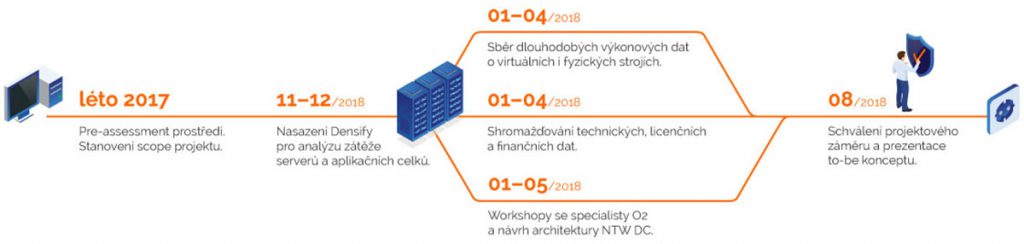
It took approximately four months to measure the actual virtual environment on more than 30 hosts, about 200 physical servers and 20 application units. Thanks to technology Densify we have gained detailed insights into the behaviour and actual power reserves of the current O2 virtual farm resources.
Through discussions with application owners and administrators, we collected technical, licensing and financial data on the metered units. At the same time, during series of workshops discussed the current and future architecture of NTWDC with O2 specialists. And after half a year we had enough... We meant data and information.
CHALLENGES FOR ORBIT
- Capacity and architectural analysis of the current NTW DC infrastructure
- Decide on the degree of synergy of NTW DC operations
- Design a new NTW DC architecture
- Quantify the TCO of the possible options
- Adapt datacenter consolidation to the schedule of the ongoing datacenter move
FROM OPINIONS TO FACTS
After a challenging aggregation of all the data and requirements, we successfully created Optimal architecture design NTW DC with a plan to consolidate all virtualizable application units into a single platform. We have clearly illustrated the necessary capacity expansion of the existing infrastructure over time, as well as the design of the newly proposed architecture.
The project plan of the preferred variant of datacentre consolidation with a calculation was subsequently submitted to the O2 Investment Committee for approval. significant savings on hardware and licences.
NTWDC operations must meet demanding criteria for continuous operation, power balancing, and availability across logically independent geoclusters. In short, NTWDC's operating conditions are much tougher than the operator's internal IT systems. After all, who would want a text message to take five minutes to arrive?
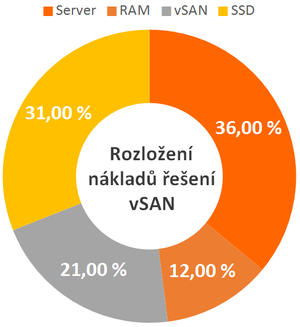
"By compiling a complete cost picture of the systems in operation, we have defended the option of converging server and data storage infrastructure into a single entity within VMware vSAN. This solution has long-term benefits in terms of performance and flexibility."
WE CAN DO IT NOT ONLY WITH IT, BUT ALSO WITH PEOPLE
When you're reconstructing road infrastructure, you can mark it with a „We need to fix this“ sign and then hide away for a few days. For NTW DC operators, however, this is not an option.
Part of the delivery of our services was therefore the phasing of the application migration so that the only necessary outages. Calm technicians = happy project sponsor.
And it wasn't just about techniques. The O2 also praised the influence of our experts on usually stubborn application administrators. Their corporate colleagues could not get them to cooperate to a comparable degree, while the mandate of a large project and external consultants with real data and experience made things move significantly.
"The key people of ORBIT have professionally and humanly fit into our team. They brought refreshing outside perspectives, unencumbered by O2's operations and internal rules, and over time the line between our employee and contractor virtually disappeared."
RESULTS FOR O2
- Designed converged NTW DC architecture based on VMware vSAN
- Future savings of 57 % of processor cores, 41 % of physical memory and 35 % of maintenance and development costs
- Limiting the risk of avoidable licensing costs for databases and middleware machines
- Build an optimal virtualization plan for applications now running on physical machines
THE NEXT DIRECTION: MORE AUTOMATION
We concluded the network datacenter consolidation project with a presentation of the future concept (75th project meeting!), namely on the originally agreed date. Satisfaction with the results of the mutual cooperation led O2 very soon to consider replatforming other technologies that were not part of the project and to further the development of the virtual platform towards greater automation.
So we have not only handed over to the client a wagonload of information and a wealth of our own experience, but also that drop of courage needed to make bold, informed decisions in the future.